RG METALS – In a tangible manifestation of synergy between the academic and industrial worlds, the Metals Research Group (RG) from the Mechanical Engineering Program, Faculty of Engineering, Sebelas Maret University (UNS) has forged a strategic collaboration with PT. SSC Works, a leading manufacturing company. This partnership focuses on an in-depth investigation to uncover the root causes behind the failure of critical heavy equipment components produced by PT. SSC Works.
The issue originated from field reports concerning several unexpected component failures that posed a risk to production efficiency. Leveraging their expertise in metallurgy and materials engineering, the UNS research team intervened to conduct an investigation akin to forensic detectives in the engineering realm.
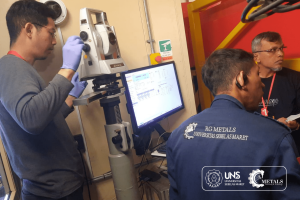
The research team from RG Metals performed not only visual observations but also utilized a series of advanced testing methods. From chemical composition analysis (X-Ray Fluorescence – XRF Method) to microstructure analysis (Metallography Method), the team meticulously mapped the characteristics of the failed components. The results revealed a discrepancy between the specified material and what was found in the field, along with several significant microstructural anomalies. Further in-depth investigation using a Scanning Electron Microscope (SEM) equipped with Energy Dispersive X-ray Spectroscopy (EDS) corroborated these findings.
The investigation unveiled a crucial insight: the failure was not caused by inherent material weakness but by a combination of deviations, potentially originating from the material supply chain at the supplier level, and the operational stresses encountered in the field. In some cases, while the component design was adequate, the material selection for its working environment was likely not according to specifications.
“This is a classic example of how industrial problems can be solved through a systematic, scientific approach,” said Prof. Dr. Triyono, ST., MT., IWE, the head of RG Metals. “Our task is not merely to find ‘who is at fault,’ but to understand ‘why it happened.’ This knowledge forms the basis for providing long-term solutions.”
Based on these findings, the Metals team provided comprehensive recommendations to the management of PT. SSC Works, ranging from evaluating component design to reduce stress concentration, to advising on stricter quality control for materials from suppliers. This collaboration not only solved a technical problem but also stands as tangible proof of how university expertise can deliver high-value, applicable solutions for the industrial world.