The Problem Addressed
The Friction Stir Welding (FSW) method is highly effective for joining aluminum alloys like AA6061-T6, which are widely used in the automotive and aerospace industries. However, single-sided FSW has its limitations. A primary concern for these components is their resistance to fatigue crack growth, as they often experience cyclic loading. Understanding and controlling fatigue behavior is crucial to prevent catastrophic failure. This research specifically investigates how the Simultaneous Double-Sided FSW (SD-FSW) process influences fatigue crack growth rate and residual stress distribution in the welded joints.
What Was Done and Found
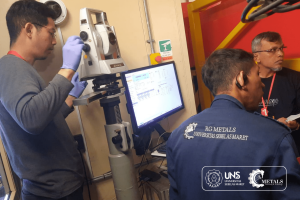
The research team performed SD-FSW on AA6061-T6 material using two different rotational speed combinations for the upper and lower tools: 955/1555 rpm and 1555/955 rpm. The resulting welded joints were then comprehensively tested for hardness, tensile strength, fatigue life, and residual stress. The results showed that the sample with the 955/1555 rpm combination had a longer fatigue life. This was attributed to the lower rotational speed on the advancing side, which produced a finer grain structure, in turn increasing hardness (129.6 HV) and tensile strength (305.1 MPa), and leading to a more favorable residual stress distribution.
Impact and Significance
This research proves that tool rotational speed is a crucial parameter in the SD-FSW process for controlling joint quality. By demonstrating that a specific combination of different speeds between the upper and lower tools can yield superior mechanical properties and fatigue resistance, this study provides valuable knowledge for industries that rely on high-strength aluminum components (such as aerospace and automotive). This knowledge is essential for producing components that are stronger, more durable, and safer against failure from repeated loading.
Citation and Link to Original Source
For technical details and complete data, please read our official publication:
Hendrato, Azka, M., Muslih, M., Apriansyah, R., Salman, N. J., Sulardjaka, Ilhamdi, Istiyanto, J., Verma, G., Kurniawan, A. D., Ansori, I., Shalahuddin, L., Valentino, J. M., Depari, Y. P. D. S., & Triyono. (2025). Fatigue crack growth and residual stress in simultaneous double-sided friction stir welded aluminum alloy AA6061-T6. Journal of Advanced Joining Processes, 11, 100300. https://doi.org/10.1016/j.jajp.2025.100300